

Most of my working day ends up as text. It may be a reply to a partner who needs an answer before their board meeting. A brief that turns a two-hour discussion into something the team can act on. Feedback I want to get right on the first try, because the person reading it will remember the wording longer than I will. And more and more often, a long explanation for an AI agent, since what it gives back depends almost entirely on how much context I give it.
For a long time, I assumed thinking was the slow part of all this. Then I started paying attention to how I actually worked. By the time I sat down to write, I usually knew what I wanted to say. The hours went into pushing it through the keyboard, sentence by sentence, while the next thought was already waiting in line. Somewhere around the third paragraph, I would catch myself trimming ideas just to finish faster.
So I started talking instead. Today I type very little of what I write. Emails, messages, documents, and prompts mostly begin as speech. Getting here took longer than I expected, and at one point it meant building my own tool, because the ones I tried kept failing me in exactly the moments that mattered.
This is the story of why I stopped typing, what got in the way, and what I would suggest to any executive who spends more of the day writing than they would like to admit.
What a CEO produces all day
If you had asked me a few years ago to describe my job in one word, I would have said decisions. Today I would choose something closer to translation. A decision only becomes useful once it leaves my head and reaches the people who have to act on it, and almost always it travels as text.
Look at an ordinary day, and the pattern is hard to miss. For example, a client asks a question that deserves a considered answer, or maybe they want a summary of what we agreed on yesterday’s call. Sometimes a team lead needs context on why we are taking a project in a particular direction or a colleague is waiting for feedback, and I know the way I phrase it will shape how they hear it. None of these take long on their own, but together, they fill every gap between meetings and then spill into the evening.
Most of this writing happens in fragments: ten minutes between calls, a few minutes at the end of a day when energy is at its lowest. Those are exactly the moments when the thought is clearest in my head, and my patience for the keyboard is shortest.
Over the last couple of years, a new reader joined the list. A large part of my work now runs through conversations with AI agents, whether I am researching a market, drafting a document, or building software. An agent has no shared history with me and no hallway conversations to fill the gaps. Everything it knows about the task comes from what I tell it. A two-line prompt gets an answer of two-line quality. A detailed explanation of the goal, the constraints, and the reasons behind them gets something I can actually use. And typing out that level of detail is precisely the step a busy person tends to skip.
So the volume of what I needed to write kept growing, while the time available to write it stayed the same. Something had to give, and for a while, it was the quality of what I sent.
Why I started talking instead
The switch didn’t start as a strategy. I began dictating the way most people do: a quick message here, a note there, mostly when typing felt inconvenient. What made me keep going was noticing what happened to the text itself.
When I type, I edit while I write. Every sentence gets weighed before the next one starts, and a lot of what I meant to say never reaches the page because it felt too long to type out. When I speak, the thought arrives whole. I explain the reasoning along with the conclusion, add the example that makes it click, mention the risk I would otherwise have saved for a follow-up call. The first version is longer and rougher, and it is also far more complete.
Speaking is also simply faster. Most people talk several times faster than they type, and for someone whose day is made of short writing windows, that difference decides whether a message gets written properly now or hastily later.
The biggest change came with AI agents. Explaining a task out loud, the way I would brief a colleague across the table, gives an agent the context it needs without me deciding which details are worth the effort of typing. The results improved almost immediately, and so did my willingness to explain things properly in the first place.
Then there were the pauses. I dictate mostly in Ukrainian, often in long stretches, and I rarely speak in finished paragraphs. I start a sentence, stop, look for the right word, sometimes wait for the next thought to arrive. Sometimes you know what you mean before you know how to say it, and I wanted a way of working that leaves room for that. Speaking does, as long as the tool on the other end treats a pause as part of the thinking.
That condition turned out to be much harder to meet than I expected.
Where the existing tools let me down
The first problem was language. I would dictate a paragraph in Ukrainian, with the language set explicitly, and get the whole thing back in another one. It didn’t happen every time, which almost made it worse. A tool that fails consistently teaches you to avoid it, but a tool that fails one time in ten teaches you to check everything.
The second was silence. Brush the hotkey by accident in a quiet room, say nothing, and a reasonable tool returns nothing. Mine returned a block of text anyway, which promptly landed in whatever window had focus. It seems like a small thing until it happens in a client chat.
The third one I almost missed. I dictated a long reflection, around fifteen minutes of thinking out loud, and the text that came back looked fine. The opening was there, and so was the conclusion. Only later did I notice that about half of it was gone, right from the middle. No error, no warning. The system reported success. That was the moment the problem stopped being about accuracy for me. A misheard word I can fix. A missing paragraph I don’t know about, I can’t.
Then there was the waiting. The longer I spoke, the longer I waited after I stopped, because transcription only began once the recording was finished. After a few minutes of dictation, I would sit looking at an empty field while the next task was already pulling at my attention. Long dictations are where I do my best thinking, and they were exactly the ones the tools handled worst.
And even when everything worked, the text often needed so much cleanup that I wondered whether I had saved any time at all. Filler words, broken punctuation, sentences I had corrected halfway through that came back with both versions intact.
Put together, all of this pointed to one thing. For an executive, a dictation tool is only as valuable as the trust you can place in it. If I have to reread every sentence to make sure it arrived complete and in the right language, I am doing the work twice. I needed something I could speak into and stop thinking about.
Building the tool I needed
At that point, I had two options. I could keep switching between tools, hoping the next one would handle my dictations better, or I could build exactly what I needed.
A few years ago, the second option would have been hard to justify. A CEO building his own software sounds like a distraction, and for most of my career it would have been one, because a project like this meant weeks of work for a team of engineers. What changed was the way software gets built. I have been an engineer for thirty years, and working with AI agents has already transformed how I approach almost every technical task. Building a tool around my own workflow stopped looking like a side project and started looking like a practical decision.
So my frustrations became the specification. Every failure from the previous section turned into a requirement. The language I speak has to come back as the language I spoke. Silence has to stay silent. A long dictation has to arrive whole, every time. And the wait after I stop talking shouldn’t depend on how long I talked.
That is how Shepit started. I won’t go deep into the engineering here. The full story, from testing speech engines on more than a thousand of my own recordings to transcribing long dictations while I’m still talking, lives in our case study on building Shepit. What matters for this article is the principle I kept coming back to while building it: hold a key, speak, release, and every word has to land.
One thing surprised me along the way. Building for myself made me stricter than I would have been with any external tool. When you are both the builder and the only user, there is no one else to blame for a missing word, and no reason to accept “good enough” when you know exactly what good feels like. Shepit has since grown beyond my own Mac, and today anyone can use it. The bar it was built against is still the one I set for myself: speak, and stop thinking about it.
How my work looks now
Most of what I write now starts with holding a key. Here is roughly how that plays out across a day.
Right after a call, while the conversation is still fresh, I dictate the follow-up: the decisions, the next steps, the nuance someone will need two weeks from now. It takes a couple of minutes and gets done before the next meeting, while the details are still sharp.
Feedback is where I noticed the biggest difference. Feedback typed in a hurry tends to come out shorter and sharper than intended. Spoken, it carries more of the reasoning and more of the tone I actually mean, and I can still read it over before sending.
With AI agents, I talk the way I would brief a colleague. I describe what I want, why it matters, what I have already tried and where I expect trouble. A few minutes of speaking replaces a prompt I would never have had the patience to type, and the quality of what comes back reflects it. For this kind of input I leave the text raw, since an agent has no use for polished sentences. For anything a person will read, I turn on AI cleanup and get text I can send as it is.
Long-form thinking changed too. Strategy notes, the outline of a difficult conversation, the first draft of an article: I can talk for ten or fifteen minutes, pausing as often as I need, and have the full text in front of me seconds after I stop. That draft is where the real editing begins, and starting from a complete thought is far easier than starting from a blank page.
And because my day moves between Ukrainian and English, I no longer think about which language I’m dictating in. I speak, and the text arrives in the language I used.
I didn’t realize how much all of this added up until I looked at the numbers Shepit keeps. So far, I have dictated more than 729,000 words across 11,735 dictations, which comes to about 132 hours of speaking. Shepit estimates that typing the same amount at an average 40 words per minute would have taken around 304 hours. Speaking at my natural pace of 92 words per minute, I saved roughly 172 hours, or about 22 working days.
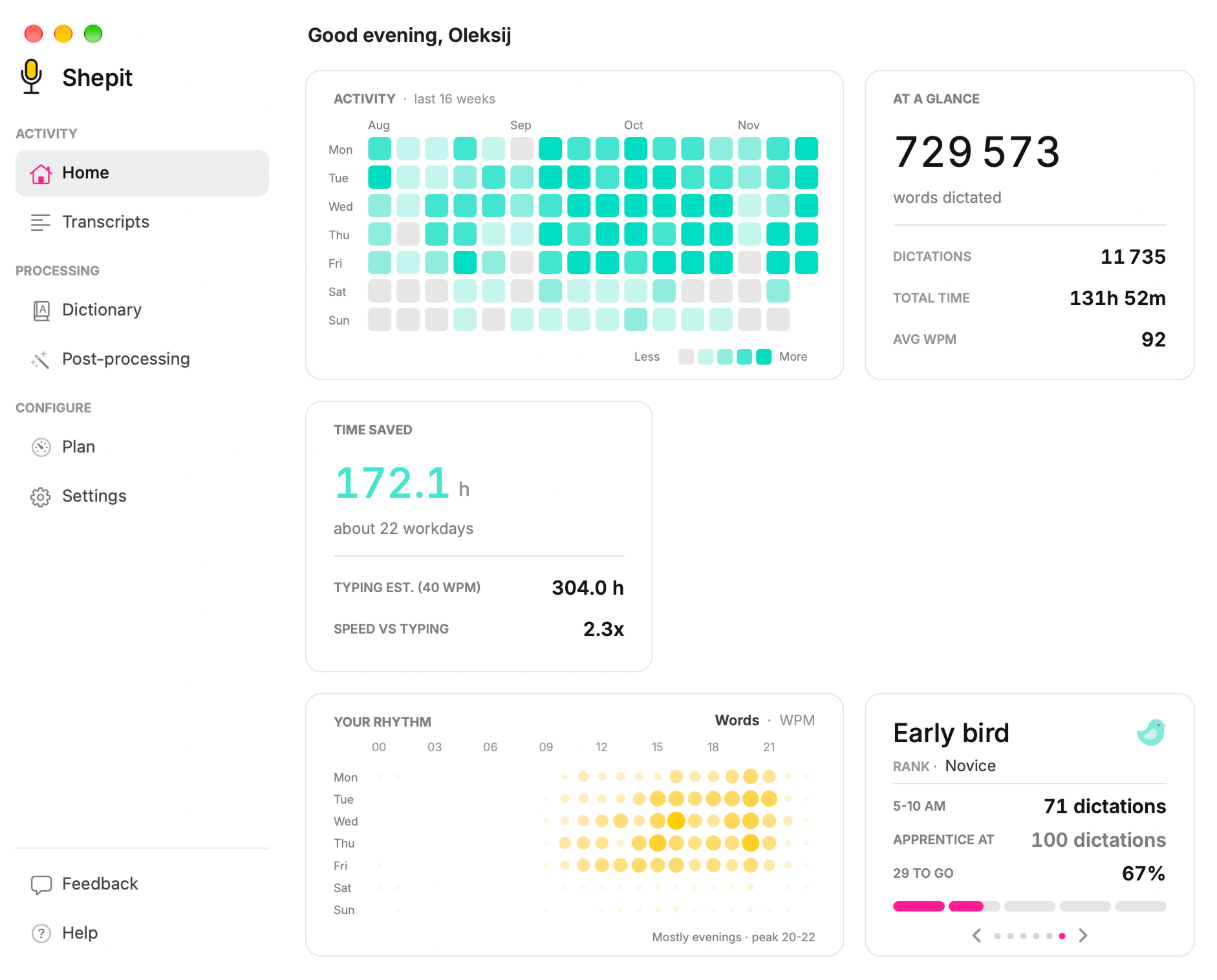
The same screen showed me something I hadn’t expected. Most of my dictation happens in the evening, with a peak between eight and ten. That is when the meetings are over and everything discussed during the day finally has to become text, and it is exactly the time I would least want to spend at a keyboard.
Of course, none of this changed how I think, but it removed the step between a thought and the page.

What I’d tell another executive
I’m not going to tell every executive to stop typing. But if a large part of your day turns into text, a few things I learned might save you some of the detours I took.
- Start with one kind of text. Pick the writing you put off most, whether that’s follow-ups after calls or briefs for your team, and dictate only that for a week. It’s enough time to see whether your texts get better as well as faster.
- Talk to AI the way you would brief a person. Explain the goal, the context, and the constraints out loud. The difference in what comes back is usually the most convincing argument for speaking.
- Judge a tool by how much you can trust it. A wrong word is easy to spot. Watch for the failures that don’t announce themselves: a missing paragraph, the wrong language, text that appears out of nowhere.
- Give yourself permission to pause. Dictation works best when you treat it as thinking out loud. Pauses are part of the process, and a good tool won’t punish you for them.
- Separate drafting from editing. Speak the whole thought first, then edit. Trying to dictate finished prose on the first attempt is what makes most people give up after a day.
- Question the habits your tools created. Some of the ways we work exist only because our tools couldn’t do better. With AI, building something that fits your workflow is much closer than it used to be.
I still type sometimes: a quick reply, a password, a line that needs to be exact. But most of what I write now starts as speech, and the texts that leave my desk are fuller, more considered, and written closer to the moment they matter.
If any of this sounds familiar, try it for yourself. Shepit is free for 30 minutes a month with no card needed, and you can test it in your browser before installing anything. Dictate your next follow-up instead of typing it and see what changes.